
How to Become an EMT in Texas: Requirements, Cost & Timeline
The real path, timeline, and cost to earn your Texas EMT certification, from a nonprofit that trains first responders in Central Texas.
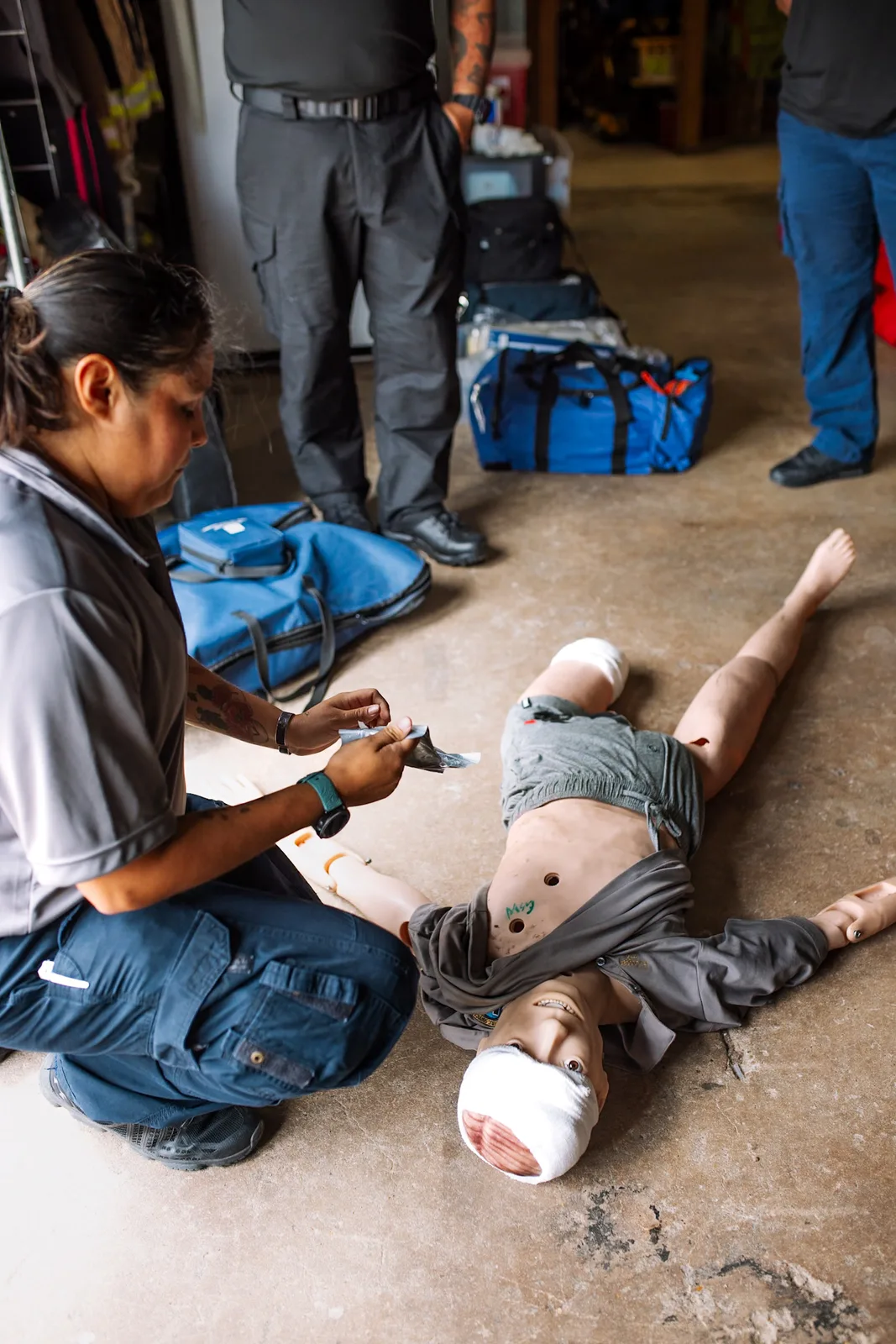
To become an EMT in Texas, you complete a DSHS-approved EMT course (classroom, skills labs, and clinical hours), pass your course, then pass the NREMT cognitive exam and psychomotor skills test, and finally apply to Texas DSHS for your state certification. You need to be at least 18, have a high school diploma or GED, and clear a background check. Start to finish, most people finish in about two months, and a full program should run somewhere around $1,750 at a nonprofit school. That's the whole path. The rest of this guide walks through each step so you know exactly what to expect.
What an EMT actually does
An EMT (Emergency Medical Technician) is usually the first trained person at someone's worst moment: a car wreck, a heart attack, a fall, an overdose. You assess patients, control bleeding, manage airways, take vitals, give a short list of medications, and move people safely to the ambulance and the hospital. EMTs work on ambulances, for fire departments, at events, in ERs, and for private services. It's hands-on work, and for a lot of people it's the front door to a long career in public safety or medicine.
The step-by-step path to EMT certification in Texas
Texas EMT certification is regulated by the Texas Department of State Health Services (DSHS). National certification runs through the NREMT (National Registry of Emergency Medical Technicians). Here's how the two fit together:
- Meet the prerequisites. Be 18 or older, have a high school diploma or GED, and be ready to pass a background check.
- Complete a DSHS-approved EMT course. This is the big piece: classroom instruction (didactic), hands-on skills labs, and clinical or field hours on an ambulance or in a hospital.
- Pass the course. You have to pass both the written material and the skills before your school can verify you to test.
- Pass the NREMT exams. A computer-based cognitive (knowledge) exam, plus a psychomotor (skills) evaluation.
- Apply to DSHS for state certification. Once you're nationally registered and your background check clears, you submit your application and DSHS issues your Texas EMT certification.
Skip a step and the whole thing stalls, so it's worth understanding each one before you enroll.
Requirements and prerequisites
The bar to start is intentionally low, because EMS wants good people from every background. To enroll and certify in Texas you need to:
- Be at least 18 years old
- Hold a high school diploma or GED
- Pass a criminal background check (a past record isn't always disqualifying, but it has to be reviewed)
- Be physically able to do the job (lifting, bending, working on your feet)
You do not need a college degree, prior medical experience, or a science background. Motivation and reliability matter more than your transcript.
How long it takes
For most students, becoming an EMT in Texas takes around two months of focused effort. TPSTA's program is built around 140 didactic hours plus 60 clinical hours, which you can move through in roughly eight to ten weeks depending on your pace and how quickly you schedule your clinicals. After the course, testing and the DSHS application add a couple of weeks. Compared with a two-year degree, this is a fast on-ramp to a real, licensed career.
What it costs
Cost is where a lot of schools get cagey, so we'll be straight with you. TPSTA's EMT program is $1,750, and that's the tuition to complete the full DSHS-approved course. Around Texas, EMT programs commonly run anywhere from about $1,000 at a community college to well over $2,500 at private academies, and many quotes leave out fees, books, or clinical costs.
Separate from tuition, you'll also pay state and national fees that go to the testing bodies, not the school: the NREMT exam fee and the DSHS certification application fee. Every Texas student pays those regardless of where they train. If money is tight, ask about scholarships. As a 501(c)(3) nonprofit, TPSTA works to keep the door open for rural and working students who'd otherwise be priced out. For a deeper breakdown, see our companion guide on what EMT school costs in Texas.
Online vs. in-person: the honest version
You'll see "online EMT course Texas" all over the internet, and here's the truth: the classroom part can be online, but the hands-on part cannot. No legitimate, DSHS-approved program certifies you fully online, because skills labs and clinical hours are where you actually learn to manage an airway or move a patient. Anyone promising a 100% online EMT cert is selling you something that won't stand up with the state.
TPSTA runs a hybrid model, which is the honest best of both. You do your didactic coursework online, on your schedule, from home. Then you come in for in-person skills labs and clinicals at our Central Texas facility. For students commuting from rural counties or working a full-time job, that mix is what makes finishing realistic.
The NREMT exam
After you pass your course, you sit for the NREMT. The cognitive exam is computer-based and adaptive, meaning it adjusts to how you're doing and stops once it's confident in your competency. The psychomotor portion is a hands-on skills evaluation where you demonstrate assessments and interventions in front of an evaluator. A good program doesn't just cover the material, it trains you to test well, because the NREMT is where underprepared students get stuck. TPSTA's curriculum is NREMT-aligned for exactly that reason.
What comes after EMT
EMT is the foundation, not the ceiling. Once you're certified and have some road time, you can climb the ladder:
- AEMT (Advanced EMT) - more advanced airway management, IV access, and a wider medication list.
- Paramedic - the top of the prehospital ladder, with advanced cardiac care, more medications, and far more autonomy. Paramedic training is longer and more intensive.
Plenty of nurses, physician assistants, and doctors started exactly where you're standing now. Getting your EMT is the first, most important step. If you're weighing where this leads, our overview of public safety careers in rural Texas lays out the options.
Frequently asked questions
How long does it take to become an EMT in Texas?
About two months for most students. TPSTA's 140 didactic + 60 clinical hour program runs roughly eight to ten weeks, plus a couple of weeks for NREMT testing and your DSHS application.
How much does EMT school cost?
TPSTA's EMT program is $1,750 in tuition. On top of that, every Texas student pays separate NREMT exam and DSHS certification fees that go to those agencies, not the school. Ask about scholarships if cost is a barrier.
Can I do EMT training online?
Partly. The classroom coursework can be done online, but skills labs and clinical hours must be in person to meet DSHS requirements. TPSTA uses a hybrid model: online didactic, in-person hands-on. Any school promising fully online EMT certification is not being straight with you.
What's the difference between an EMT and a Paramedic?
An EMT provides basic emergency care. A Paramedic has advanced training, gives more medications, and performs advanced procedures. Paramedic is a later step; EMT is the required foundation.
Do I need a background check?
Yes. Texas requires a criminal background check for certification. A past record isn't an automatic disqualifier, but it has to be reviewed, so talk to us early if you have concerns.
Is TPSTA's program DSHS-approved?
Yes. TPSTA's EMT program is a DSHS-approved, NREMT-aligned course, so completing it puts you on the recognized path to Texas certification.
Ready to start?
If you're serious about becoming an EMT in Texas, the next step is simple: pick a program and pick a start date. TPSTA is a nonprofit training academy in Bastrop, serving Central Texas and rural communities with affordable, DSHS-approved training that doesn't cut corners.
See TPSTA's EMT program and the next class start.
You can also browse all TPSTA programs to see where an EMT certification can take you.